Email Warm-Up: The First 30 Days of a New Sending Domain
The first time I blasted 5,000 emails from a brand new domain, I thought I was being strategic. Smaller than my usual list. Opt-in recipients. Solid copy. What could go wrong?
Everything, it turned out. Within hours, the domain was effectively blacklisted. Gmail flagged it. Outlook treated it like malware. The campaign's performance was horrific, and the domain never really recovered. I had to burn it and start over.
That's when I learned the hard way what email warm-up is. And why the first 30 days of a new sending domain are the most fragile — and the most important — of its entire life.
What Email Warm-Up Actually Is
Email warm-up is the process of gradually building a reputation for a new sending domain (or a new IP) by slowly increasing your sending volume, starting small, and aiming for high engagement early on.
Mailbox providers don't trust unknown senders. Gmail doesn't know you. Outlook doesn't know you. To them, a brand new domain sending 5,000 emails looks exactly like a spammer. It doesn't matter how legitimate your list is — you haven't earned the benefit of the doubt yet.
Warm-up is how you earn it.
Think of it like a credit score. A new credit card starts with no history. The bank doesn't give you a $50,000 limit on day one. They give you $500, watch how you use it, and slowly raise your limit as you prove you pay on time. Same logic.
When You Need to Warm Up (And When You Don't)
You need to warm up in four specific situations:
You just registered a new domain. You set up a new subdomain for sending (like mail.yourdomain.com). You moved to a dedicated IP address. You haven't sent email from this domain in 60+ days (it's gone "cold").
You probably don't need a full warm-up if you're just switching ESPs but keeping the same domain and you've been sending consistently. In that case, a shortened ramp-up of 1-2 weeks is usually enough.
But for any truly new domain, a full 30-day warm-up is the safer path. Cutting corners here is how domains die.
Before Day 1: Setup Checklist
Don't even think about warm-up until these are in place.
Domain authentication: SPF, DKIM, and DMARC all configured and tested. DMARC at p=none for now — you'll tighten it later.
A separate subdomain for sending. Do not warm up your main company domain. Use something like send.yourdomain.com.
Clean email addresses from a verified list. Run them through an email checker first. A single bounce in the warm-up phase hurts more than a hundred bounces do in month six.
A real sender name. "John from Company" is better than "Company Marketing Team" and infinitely better than "noreply@".
Working unsubscribe link. This is required by law in most countries and also a trust signal.
The 30-Day Warm-Up Plan
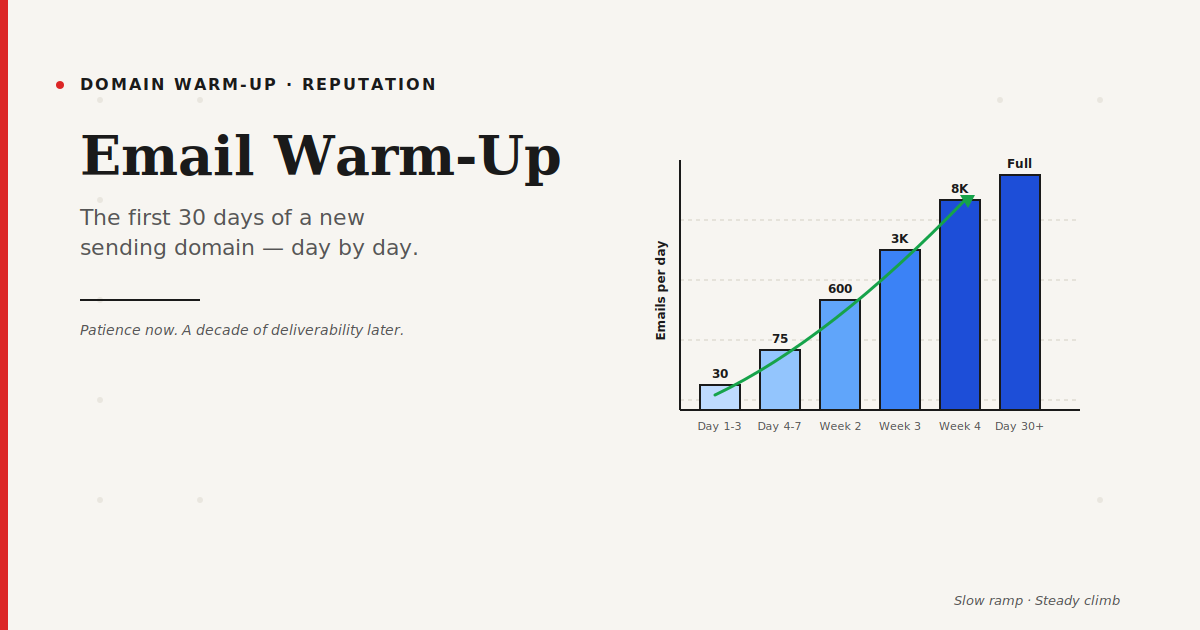
Here's the plan I've used with dozens of new domains. It's conservative, which is what you want.
Days 1-3: The Friendly Introduction
Send 20-30 emails per day, only to your most engaged recipients — people who replied to you recently or opened every previous email you ever sent. Use plain text. No images. No complex HTML. Just a simple, conversational note that might genuinely get a reply.
Goal: at least a few opens and, ideally, replies. Replies are pure gold for reputation.
Days 4-7: Small Volume, Real Content
Increase to 50-75 emails per day. Still only engaged recipients. You can start adding light HTML — a logo, maybe one link — but keep it simple. Monitor your bounce rate daily.
Goal: maintain open rates above 30%. If they drop, slow down.
Days 8-14: The Gradual Ramp
Double roughly every 3 days: 150, then 300, then 600 per day. Begin expanding your audience slightly to include recently active subscribers. Keep watching engagement.
By day 14, you should be sending around 500-1,000 per day comfortably.
Days 15-21: Widening the Audience
Increase to 1,500-3,000 per day. You can now include subscribers who've opened something in the past 60 days. Vary your send times slightly so you don't look robotic.
If your bounce rate stays under 1% and your open rate above 20%, you're on track.
Days 22-30: Approaching Normal Volume
Ramp toward your target daily volume. By day 30, you can typically be sending at your intended pace, assuming the metrics stayed healthy.
This is also when you'd tighten DMARC from p=none to p=quarantine, then eventually to p=reject.
What to Watch Every Single Day
During warm-up, monitor these metrics daily. Yes, daily. It's 5 minutes of work that prevents disasters.
Bounce rate: should be under 1%. Any spike means stop and diagnose.
Open rate: should be high, because you're sending to engaged people. If it drops, your content or list quality needs work.
Spam complaints: should be effectively zero. Even one or two complaints in warm-up are a serious warning sign.
Google Postmaster Tools: check daily once you have enough volume for it to report data. Watch the domain reputation graph like a hawk.
Automated Warm-Up Tools: Are They Worth It?
You've probably seen tools like Mailwarm, Lemwarm, Warmup Inbox, and similar. They automate a network of "real-looking" inboxes that exchange emails with your domain to build reputation.
Honest take: they help, but they're not magic. They work better for sales outreach domains than for marketing ESPs. And Gmail has gotten better at spotting the behavior patterns these tools create.
My advice: for marketing lists, rely on real engaged subscribers during warm-up. For cold outreach domains, a warm-up tool can be a useful supplement, but never a replacement for good list hygiene and sending practice.
Common Warm-Up Mistakes
The things that kill warm-ups, in my experience:
Starting too fast. Sending 1,000 emails on day one, just because your list is "warm." Doesn't matter. The domain is cold.
Ignoring bounces. Even one hard bounce on day one is meaningful. It signals carelessness.
Using too many images and links too early. Heavy HTML emails from a new domain look promotional. Plain text emails build trust faster.
Blasting a cold list mid-warm-up. You do not send to cold subscribers during days 1-20. Ever.
Not having replies. Replies tell mailbox providers "this is a real conversation." Solicit them in your early emails. Ask a genuine question.
What "Warmed Up" Actually Looks Like
A properly warmed-up domain has these traits after 30 days:
Open rates consistently at or above 25%. Bounce rate under 1%. Spam complaint rate under 0.05%. Domain reputation in Google Postmaster showing as "Medium" or "High." Authentication (SPF, DKIM, DMARC) passing on every send.
If you've hit those markers, your domain is ready for full production sending. Congratulations — you now have a real asset. Take care of it.
Final Thought
Email warm-up feels frustrating when you're in it. You have a list ready to go. You have a campaign ready to send. And this guide is telling you to slow down, send 50 emails, and wait.
Do it anyway. Every domain I've seen rushed ended up either underperforming for months or getting burned entirely. Every domain I've warmed up properly has been a reliable sender for years afterwards.
30 days of patience. A decade of deliverability. That's the trade.
FAQ: Email Warm-Up
How long does email warm-up take?
Around 4-6 weeks for a brand new domain. Some senders extend it to 8 weeks for very high volumes (100k+ per day). The more gradual, the safer.
Can I skip email warm-up if my list is clean?
No. List quality doesn't matter to a new domain — mailbox providers don't know that your list is clean. They only know your domain has no history. Warm-up is about building that history.
Do I need to warm up a new subdomain if my root domain is already warm?
Yes, but you can do a shorter warm-up. Subdomains build their own reputation, but they inherit some trust from a well-aged root domain. 10-14 days is usually enough.
What happens if I skip warm-up and blast my list?
Most of your emails will go to spam, your domain reputation will tank, and you'll spend weeks or months recovering. Some domains never fully recover and have to be abandoned.
Should I warm up with a warm-up tool or with real emails?
For marketing domains, real engaged subscribers are better. For cold outreach domains, a dedicated warm-up tool can supplement real activity, but shouldn't replace it. Real engagement is still the strongest trust signal.
Related Reading
- Email Checker: Why Skipping This Step Is Killing Your Campaigns
- How to Improve Email Deliverability: A Practical Guide
- SPF, DKIM and DMARC Explained Without the Jargon
- Why Your Emails Land in Spam (And How to Fix It)
- Cold Email Templates That Don't Feel Like Cold Emails
- The Best Email Marketing Tools Compared