The Best Email Marketing Tools Compared (An Honest Review)
I've probably tried every major email marketing tool on the market in the last decade. Not because I'm indecisive. Because I keep being surprised by how different they actually are once you live inside them for a few months.
Reviews online tend to be either fluff (everything is "amazing") or commissioned by affiliates. So here's something different: an honest, opinionated breakdown of the best email marketing tools — what each one is genuinely good at, where it falls short, and who it actually fits.
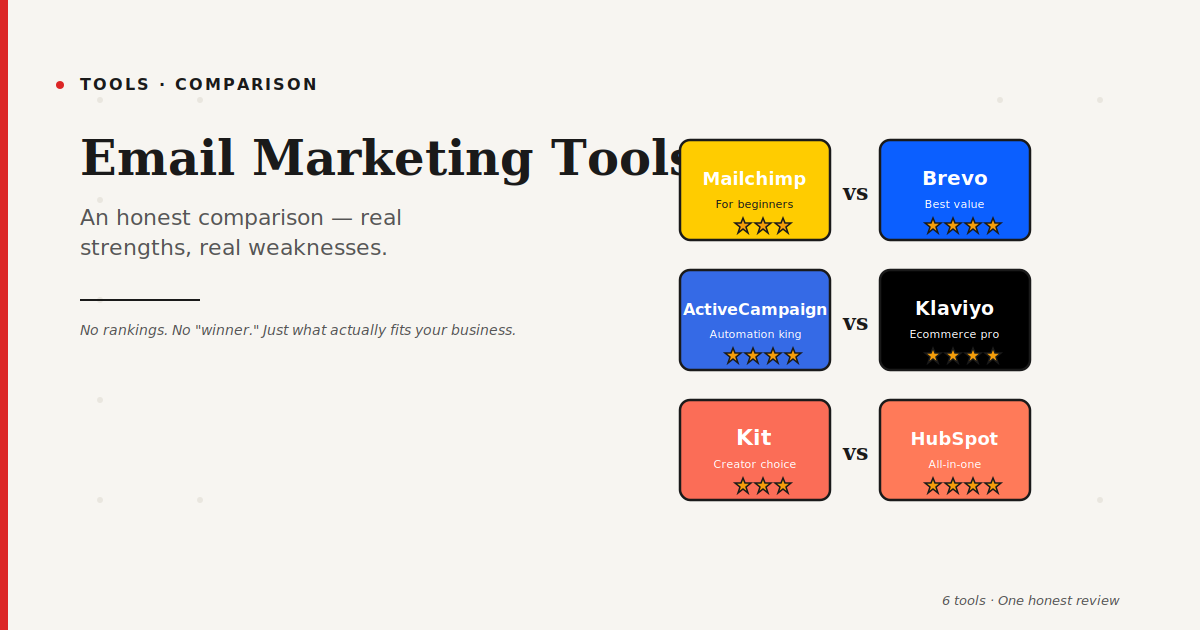
No rankings. No "winner." Because the best email marketing tool depends entirely on what you're trying to do.
Mailchimp: The Default That's Not Always the Answer
Mailchimp is the most recognized name in email marketing for a reason. It has a polished interface, a generous free tier, and templates that make it easy for beginners to send good-looking emails.
What it's good at: onboarding new email marketers, simple newsletters, basic automations, straightforward analytics. If you've never sent an email campaign before, you'll be productive in Mailchimp within an hour.
Where it falls short: it gets expensive fast as your list grows. Automations are less powerful than what you'll find in the more specialized tools. Deliverability is decent but not industry-leading. And the pricing model (charging based on total subscribers, even inactive ones) punishes you for list size, not list quality.
Good fit for: small businesses, newsletter writers under 5,000 subscribers, and first-time email marketers who want polished output without a learning curve.
Brevo (formerly Sendinblue): The Best Value Play
Brevo rebranded a couple of years ago, and honestly, it's the tool I recommend most often for price-conscious businesses with growing lists.
What it's good at: pricing based on emails sent, not subscriber count, which is a much fairer model for many senders. Solid deliverability. Built-in SMS marketing, transactional email, and a CRM. Free tier is generous enough to actually run a small business on.
Where it falls short: the interface feels less polished than Mailchimp or Klaviyo. Template editor is functional but not inspiring. Advanced automation logic requires some getting used to.
Good fit for: small to medium businesses, anyone sending to a large list where Mailchimp's per-subscriber pricing becomes painful, and teams that want email + SMS + transactional in one place.
ActiveCampaign: The Automation Powerhouse
If your email strategy depends on complex automations — behavior-triggered sequences, conditional branches, lead scoring, multi-channel workflows — ActiveCampaign is still one of the best in the business.
What it's good at: automation flows that genuinely feel like they're made for real marketers. Deep CRM integration. Excellent segmentation. Reliable deliverability. A huge library of automation recipes to start from.
Where it falls short: steep learning curve. Pricing jumps quickly as you add features. The interface can feel dated compared to newer tools. Template design is functional but not a strength.
Good fit for: B2B businesses, agencies, SaaS companies, and anyone who lives and breathes automation. If you're going to build lifecycle email sequences with serious logic, this is where to do it.
Klaviyo: The Ecommerce Specialist
If you're running an ecommerce business — Shopify, WooCommerce, BigCommerce — Klaviyo has become the de facto standard, and it earns that position.
What it's good at: deep ecommerce integrations that surface real revenue data inside your email tool. Predictive analytics (predicted next order date, customer lifetime value). Strong SMS add-on. Abandoned cart and post-purchase flows that actually work.
Where it falls short: expensive as you scale, especially past 10,000 contacts. Overkill for anyone not running ecommerce. Interface has improved a lot but can still feel dense.
Good fit for: any ecommerce business above $500K/year in revenue. If you're below that, the value is harder to justify. Above it, Klaviyo usually pays for itself in recovered revenue.
ConvertKit (Now Kit): The Creator's Choice
Kit (the rebrand of ConvertKit) built a reputation around one specific audience: newsletter writers, creators, course sellers, and authors. It shows.
What it's good at: clean, content-focused email interface. Strong landing page and signup form builder. Simple automation that non-technical creators can actually use. Excellent deliverability.
Where it falls short: less robust than ActiveCampaign for complex B2B workflows. Reporting is cleaner but shallower. Not built for transactional email.
Good fit for: solo creators, newsletter operators, course sellers, and any business where email is the product (rather than a support channel for the product).
HubSpot: The All-In-One Sledgehammer
HubSpot isn't really an email marketing tool. It's a CRM that includes email marketing. That distinction matters.
What it's good at: unified view of marketing, sales, and service in one platform. Email tightly integrated with the CRM. Excellent for alignment between sales and marketing teams. Reporting that ties email to revenue cleanly.
Where it falls short: expensive, especially once you unlock advanced features. The free tier has significant limitations on email sending. Complex for small teams that don't need the CRM.
Good fit for: B2B companies with sales teams, mid-market businesses ready to consolidate multiple tools, and anyone whose email is part of a larger sales-driven funnel.
MailerLite: The Quietly Solid Option
MailerLite doesn't get the same marketing push as Mailchimp or Brevo, which is a shame. It's a genuinely good, affordable tool that flies under the radar.
What it's good at: clean interface, good deliverability, fair pricing, and a surprisingly capable free tier. Landing pages and websites built in. Good for newsletter-style sending.
Where it falls short: fewer integrations than bigger names. Automation is less sophisticated than ActiveCampaign or Klaviyo. Some features feel like they're catching up to competitors.
Good fit for: bootstrapped businesses, solopreneurs, and anyone who wants Mailchimp-level usability at better prices.
Postmark and SendGrid: The Transactional Specialists
Quick note on these, because people sometimes conflate them with marketing tools.
Postmark and SendGrid are primarily for transactional emails — the password reset emails, order confirmations, and system notifications your app sends to users. They're not designed for marketing campaigns, but they excel at what they do.
Postmark has arguably the best deliverability for transactional mail in the industry. SendGrid is more flexible but also more complex.
If you're sending marketing emails, you need a marketing tool. If you're also sending transactional emails (and most businesses are), you likely want a dedicated tool for that too. Don't try to do both from one platform unless you specifically picked it for that.
How to Actually Choose
Forget feature matrices for a second. Here's the practical framework I use:
Under 2,000 subscribers, just starting: Mailchimp, MailerLite, or Brevo's free tier. All three will work. Pick the one whose interface you find most enjoyable.
Running an ecommerce store: Klaviyo if revenue justifies it, Brevo or MailerLite if you're early-stage.
Running a newsletter or creator business: Kit (ConvertKit) or Beehiiv. Built for your use case.
B2B with a sales team: HubSpot if budget allows, ActiveCampaign if you want more flexibility at lower cost.
Complex automation needs: ActiveCampaign. Still the best at this.
Large list, cost-sensitive: Brevo or MailerLite.
What Most People Get Wrong When Choosing
One pattern I've noticed: people choose the tool with the most features, then use 20% of them. Features you don't use aren't a benefit — they're clutter that makes the tool harder to use for the things you actually do.
Another pattern: people switch tools too often chasing marginal improvements. Migration is expensive in time and disruption. Better to pick a "good enough" tool and master it than to perpetually flee to the next trendy option.
The best email marketing tool is the one you actually use consistently. Anything else is theoretical.
Final Thought
Email marketing tools have gotten shockingly good. Almost all of the options above will handle your email sending, your automations, and your reporting competently. The differentiation is in the fit — whether the interface matches how you think, whether the pricing fits your growth curve, whether the specific features solve your specific problems.
Pick one. Commit for at least 6 months. Learn it deeply. The tool matters less than the practice.
And whichever you pick, remember the invisible things matter more than the features. Clean list. Warmed-up domain. Proper authentication. Real engagement. Those are the actual determinants of email marketing success. The tool is just the vehicle.
FAQ: Email Marketing Tools
What is the best email marketing tool for small businesses?
For most small businesses under 5,000 subscribers, Mailchimp, Brevo, and MailerLite all work well. Mailchimp has the most polish, Brevo has the best pricing model for growing lists, and MailerLite is the most affordable option with a solid free tier.
What's the best email marketing tool for ecommerce?
Klaviyo is the industry standard for ecommerce email marketing, especially for Shopify stores doing more than $500K annually. For smaller ecommerce businesses, Omnisend or Brevo can be more affordable alternatives with decent ecommerce features.
Is there a truly free email marketing tool worth using?
Brevo, MailerLite, and Mailchimp all offer real free tiers. Brevo's free plan (300 emails/day) is the most generous for smaller lists. MailerLite offers up to 1,000 subscribers free. Mailchimp limits you to 500 contacts and 1,000 emails/month.
Should I use the same tool for marketing and transactional emails?
Ideally, no. Marketing tools are optimized for campaigns; transactional services like Postmark are optimized for single high-deliverability messages. Mixing them on the same domain can also hurt deliverability. Use separate tools when possible.
How often should I switch email marketing tools?
As rarely as possible. Migrations are painful, disrupt reporting continuity, and usually solve less than expected. Switch only when the current tool is genuinely blocking something you need, not because a newer tool looks shinier.
Related Reading
- Email Checker: Why Skipping This Step Is Killing Your Campaigns
- How to Improve Email Deliverability: A Practical Guide
- SPF, DKIM and DMARC Explained Without the Jargon
- Email Warm-Up: The First 30 Days of a New Sending Domain
- Why Your Emails Land in Spam (And How to Fix It)
- Cold Email Templates That Don't Feel Like Cold Emails